

Intro
If you write fantasy or sci-fi, you’re likely going to find yourself dealing with characters who speak languages that don’t exist in the real world. Maybe there are going to be aliens or orcs or even just regular old humans who, for one reason or another, don’t speak a regular Earth language. Which means you might have to come up with your own.
I think a lot of writers—understandably—get intimidated by the idea of coming up with a language for their stories. I mean, we’ve all heard stories about Tolkien and his super meticulous planning of the Elvish language for Lord of the Rings, right? What if we don’t have the time or patience to do that sort of thing ourselves? (Though, if you do, please feel free to do so.) Well, the good news is that, while it’s cool to come up with a real, functioning language like Tolkien did, it’s not actually necessary if all you’re going to do with it is use it for a few snippets of dialogue in your book.
So, what is necessary? Well, that’s what I’m going to talk about in today’s post.
When Is It Necessary to Come Up With a Language?
First of all, we should talk about figuring out whether you even need to go through the trouble of coming up with a fictional language or not. Obviously, this is largely a matter of opinion and narrative style, so I’m just going to share what I think, and you can agree or disagree as you see fit. Feel free to come to your own conclusions.
Some people might automatically say that you should come up with a new language whenever one comes up in your book. (Duh.) This could work for some stories but for me, as a fantasy writer, this would be super unsustainable. Because, technically, no one speaks a real world language in my books. (They’ve never even heard of English, let alone speak it, even though that’s what I wrote the book in.) So, if I were to try to come up with every single language, then literally all of the dialogue would be written in whatever my made-up language is. And I don’t think I have to tell you that that would make it super hard and miserable to read.
So my rule is that the POV character’s main language—usually Common, in my books—is always automatically translated to English. A lot of the time, the same goes for any other languages the character is fluent in; if the POV character understands what’s being said in Elvish, the reader should too, because they’re supposed to be in the character’s head. Otherwise, there can sometimes be a bit of a weird disconnect, which I try to avoid.
I do actually come up with words for languages that the POV character doesn’t understand, and for words that aren’t supposed to have a direct English translation, regardless of whether the character understands them or not. The reason for the latter is pretty self-explanatory, but I’ll explain the former. If the POV character doesn’t understand what’s being said, then the words will sound like nonsense to them—which is exactly what the words will look like on the page to the reader. If the character doesn’t understand, then the reader doesn’t either.
Before we move on, though, I do want to say that I don’t think it’s ever totally necessary to come up with a fictional language. It’s totally acceptable to just say something like “He said something in what I thought was Orcish,” or “She asked ‘Can I get you some tea?’ in Elvish.” Like the vast majority of writing, it really just comes down to style and what you want to do. If you’re like me and think it’s fun to come up with languages, do it. If you don’t, don’t. Trust me when I say your story won’t suffer either way.
Creating Words and Grammar
My method for creating a fictional language is probably about the least elaborate one I’ve ever seen. I don’t really plan them at all, to be honest; I just come up with them as I’m writing. The reason for this is simple: it saves time in what could be a tedious process, in more ways than one.
What I do is, when I come to a part in the story where I want someone to use a made-up language, I first figure out what I want them to say in English—most of the time, I even type it out. Then I start thinking about how they could say it in the fictional language, using made-up words and maybe with a different grammatical structure than English uses. I usually already kind of know the general vibe I want the language to have—airy and melodic for elves, probably with a lot of “a”s and “i”s; hard and guttural for orcs, probably with a lot of “g”s and “k”s—so I just come up with nonsense words that fit the feel I want. (Very sophisticated, huh?)
As for the grammar, I usually keep it pretty simple. The thing I pay the most attention to is whether the subject of a sentence goes after the adjective, like in English, or whether the subject goes before the adjective, like in Spanish—just because that’s usually the most obvious grammar difference to me between languages. You can obviously get as detailed with this as you want but, for me, this is enough to get the point across.
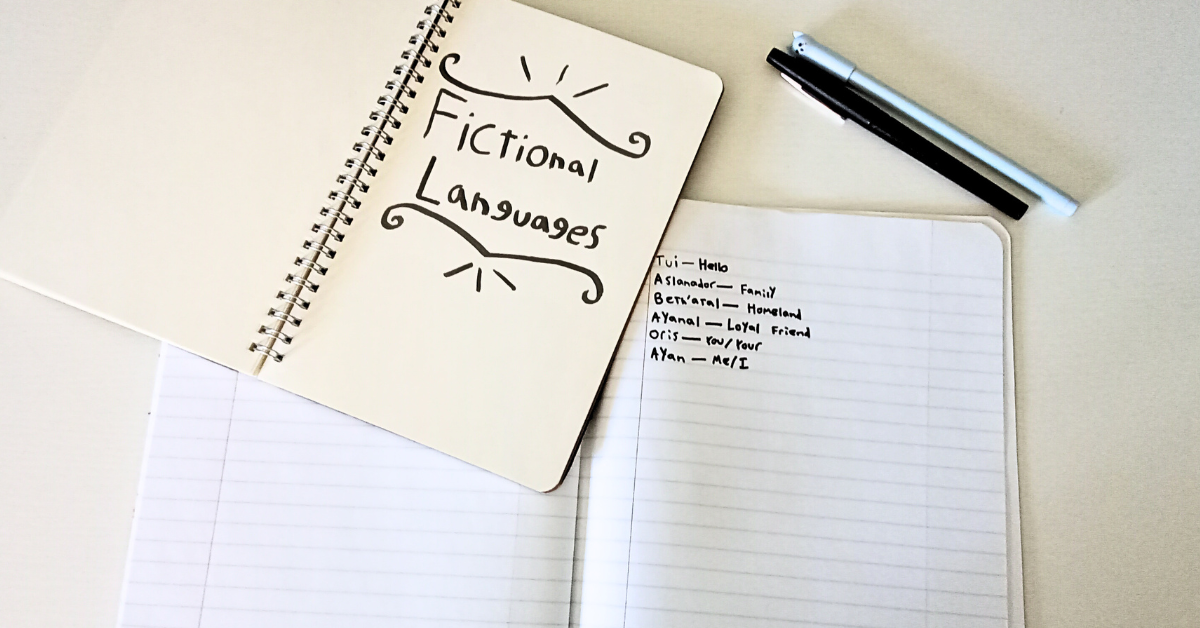
Once I’ve successfully crafted that single bit of dialogue, it’s time for the most important step: record the words I used. I usually have a notebook or document on my computer where I list all of the words from the fictional language that I’ve used in the story, with their English translations right next to them. This way, I never forget what a word means and, if I have to make the characters say that word in that language again later on, I can make sure I’m using the same one. And, as I write more dialogue in that language in the story—following the exact same steps that I outlined above—my list of words and translations will get longer and longer. Eventually, I’ll probably have all of the words that I use the most sitting on that list, ready to put to use. It’ll be like I did sit down and meticulously plan it out, but with one key difference: I didn’t have to waste time agonizing over coming up with words that I’m not even 100% sure I’m going to use. This way, I know that just about every word I come up with is actually going to be used in the story.
How to Use a Fictional Language
Like I mentioned earlier, I mostly use fictional languages when the POV character doesn’t understand the language themself. But there are obviously other instances where you could use them too; when you use them is ultimately up to you. In this section, I’m just going to share some other ideas for times when you could use them.
Although I haven’t done this much in my more recent writing (mostly just because it hasn’t come up), I sometimes like to have conversations that aren’t in the usual language of the story start out with me writing the dialogue in the language they’re speaking, then transition to writing it in English as it goes on, while making a point of mentioning that they’re still talking in Dwarvish or whatever. I’ll give an example so that you can see what I mean:
“Vel jovtic ot kazak?” Netta asked in Dwarvish. How goes the mining?
“Asa jakul…” Denthor replied glumly. Could be better…
“Ah, lighten up,” Netta said, still speaking in Dwarvish. She placed a hand on his shoulder. “The day’s still young; I’m sure you’ll find something!”
“I hope you’re right.”
So, as you can see, I started out writing the dialogue in the actual language that the characters are speaking—Dwarvish—then transitioned to just immediately translating everything to English as the conversation went on. This method is great for if you want to give the reader an idea of what the language actually sounds like, without super bogging down the narrative with unfamiliar words.
You probably also noticed in the example that, even when I was writing their dialogue in Dwarvish, I was still translating to English on the same line. This is another strategy that I like; it’s basically like using subtitles in a movie, where the reader sees the dialogue in the language it’s being spoken in, but you’re still telling them what’s being said. I do try to use this sparingly, though; writing a long conversation, or even a long chunk of dialogue, like this could get really…well, long, because you’re literally saying everything twice. So I usually save it for short exchanges or use it more like I did in the example, where I open it like that, then ultimately end up writing most of it in English.
Both of the methods I mentioned above are ones that I really only use if the POV character understands the language that’s being spoken—because, you know, they’d be able to translate it. If the POV character doesn’t understand a language, but you still want to give the reader an idea of what’s being said, there are things you can do there too. The easiest is to have it that the POV character has another character who’s willing to translate for them; that way, the other character could translate it in a way that feels natural. If the character isn’t so fortunate as to have someone willing to translate, then you’re going to have to rely solely on the POV character’s ability to read people’s tones and body language and come to their own conclusions. Obviously, this is probably going to result in a very rough translation—at best—but it’s probably the best you’re going to get.
Another easy way to incorporate your fictional language—regardless of whether the POV character is fluent in it or not—is to have characters mix it with whatever the main, always-translated language is. Lots of real bilingual people do this, naturally using words from two different languages in the same sentence without giving it a second thought, so there’s no reason why your bilingual characters can’t do it too. Like, if your main language is Common, maybe you have an elf character who says most things in Common, but naturally switches to Elvish when they’re saying certain words or phrases. Just make sure you translate what they’re saying in some way, so the reader can follow. (Though I’d also like to note that you don’t necessarily have to translate every single time, particularly if the made-up word is used a lot throughout the story. Like, if your elf character is always using an Elvish word that means “dear friend,” you can probably get away with only translating it the first time they say it.)
Outro
Creating a fictional language can seem like a huge task, but it doesn’t have to be as hard as you’d think. By using the strategies that I covered in this post, you can hopefully save a lot of time and frustration.
That’s all for today’s post! I hope you found this interesting, and that you’ll check back next month for my next writing post. Thanks for reading!


